


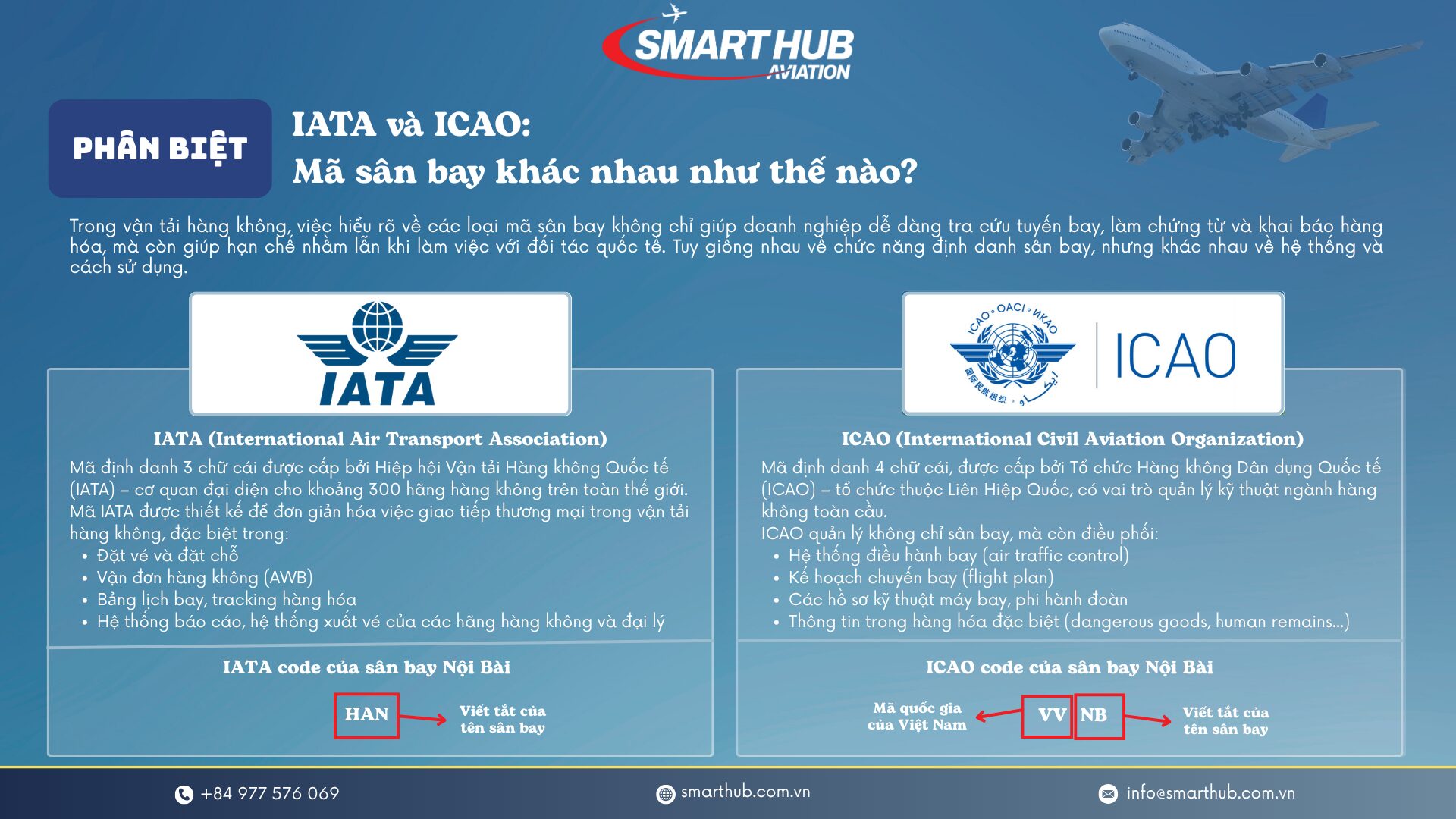
Distinguishing Between Iata And Icao Airport Codes In Air Freight Logistics
In the air freight industry, understanding different types of airport codes is a critical factor that enables businesses to efficiently track flight routes, declare customs information, and coordinate with international partners. The two most common code systems are the IATA and ICAO codes—both designed to identify airports, yet differing significantly in usage and function.
 1. IATA Code – Simplifying Commerce and Operations
IATA – Airport Codes Established by the International Air Transport Association.
The International Air Transport Association (IATA), representing around 300 global airlines, has developed a system of three-letter airport codes to simplify air transport operations in international commerce.
IATA codes are designed to support daily operations and information processing across the logistics and aviation sectors. Key applications include:
- Flight booking and reservations: Airlines use IATA codes to publish flight schedules and destinations.
- Air Waybills (AWB): These legal documents for cargo shipments clearly state the origin and destination airports using IATA codes.
- Flight schedules and cargo tracking: IATA codes appear in tracking systems used by airlines and freight forwarders.
- Reporting systems and ticket issuance: IATA codes streamline statistics on flights, cargo volumes, and passenger numbers.
Example: The IATA code for Noi Bai Airport is HAN, representing Ha Noi.
2. ICAO – Codes for Global Air Traffic Management and Technical Operations
ICAO – Airport Codes Established by the International Civil Aviation Organization.
The ICAO (International Civil Aviation Organization) is a United Nations agency responsible for developing global standards and technical regulations for the aviation industry.
ICAO assigns four-letter airport codes used primarily for technical and operational purposes in air traffic management and logistics. These codes play a critical role in:
- Air Traffic Control (ATC): ICAO codes enable precise identification of every airport worldwide to ensure flight safety.
- Flight Planning: Every international flight must file a flight plan that includes the ICAO codes for the departure and arrival airports.
- Navigation and Coordination Systems: ICAO codes are essential for pilots, air traffic controllers, and radar systems to accurately identify airport locations.
- Handling Special Cargo: ICAO codes help classify and manage the transport of special goods like Dangerous Goods (DGR), Live Animals (AVI), and Human Remains (HUM) in compliance with international safety standards.
Example: The ICAO code for Noi Bai International Airport is VVNB, where:
- The first two letters (VV) denote the country code for Vietnam.
- The last two letters (NB) are an abbreviation of Noi Bai.
>>>> RELATED READING: Classification of Cargo Types in Air Freight
3. Why Logistics Businesses Must Understand the Difference

IATA and ICAO codes may share the same purpose of airport identification, but they differ significantly in usage and function.
Accurately distinguishing between IATA and ICAO codes is crucial in air freight operations—especially for logistics providers, freight forwarders, airlines, and import-export businesses. Here’s why:
- Avoiding document errors: In transport documents (such as the Air Waybill, shipping labels, invoices, or customs paperwork), airport codes must follow international standards. Using the wrong type—mistaking IATA for ICAO or vice versa—can result in system rejections, shipment delays, or routing errors.
- Route planning and flight coordination: For freight forwarders, understanding ICAO codes enables accurate planning of air cargo routes, particularly for international or specialized shipments. Modern tracking systems also rely on ICAO codes to build route maps and update flight locations in real time.
- Data integration with international partners: Airlines, overseas clients, and digital logistics platforms (e.g., CargoWise, SkyChain, OneRecord) often require standardized data formats using specific IATA or ICAO codes. Incorrect codes can disrupt order processing and shipment coordination.
- Enhancing operational professionalism: For logistics companies or General Sales and Service Agents (GSSA), using the correct code in the right context demonstrates industry knowledge and builds trust with international partners.
- Supporting special cargo operations – safety & security: For hazardous goods, perishables, or high-value shipments, precise documentation is essential. ICAO codes serve as a legal basis to ensure safety throughout the transportation journey.
>>>> YOU MAY ALSO BE INTERESTED IN: Choose the Right Air Route – Optimize Cost and Transit Time
Smart Hub Aviation – Your Trusted Partner Across Every Flight Route
As a dedicated air cargo agent and strategic partner to numerous domestic and international airlines, Smart Hub Aviation not only possesses deep expertise in airport code systems, but also offers tailored air freight solutions for each cargo type and flight route.
We provide support in:
- Consulting on optimal route selection (direct flights, single-transit, multi-transit routes)
- Standardizing transport documentation in compliance with IATA/ICAO codes
- Assisting with customs declarations and accurate port/cargo code verification
- Offering consolidation, deconsolidation, and airport warehousing services
- Advising on the handling of special cargo: dangerous goods, temperature-sensitive, or high-security shipments
>>>> READ MORE: Comprehensive Air Freight Solutions from Smart Hub Aviation
Contact Us:
- Hotline: +84 977 576 069
- Email: info@smarthub.com.vn
- Fanpage: Smart Hub Aviation
Share the posts
.svg)
.svg)
.svg)
 Copied
 Blog Related

E-commerce Cargo – Fast & Efficient E-commerce Shipping Solution

Vietnam Air Cargo Transport: Breakthrough in the First 9 Months of 2025 – A Golden Opportunity for Import–Export Businesses

Van Don International Airport – The Golden Gateway for Air Cargo Transport

China Opens 152 New Air Cargo Routes – A Golden Opportunity to Strengthen Vietnam’s Supply Chain Connectivity

Air Cargo During the Vietnam National Day: Strong Growth in Cargo Volume Creates Opportunities for Vietnam’s Logistics Industry


