


Da Nang Optimizes Operations of Two Airports: A New Driving Force for Air Freight and Logistics
After the administrative merger with Quang Nam, the newly expanded Da Nang City now holds a rare advantage: two strategic airports – Da Nang and Chu Lai. Clear planning and functional allocation between these two airports not only unlocks strong development potential for the central coastal region, but also presents a significant opportunity for the logistics and air cargo sectors.
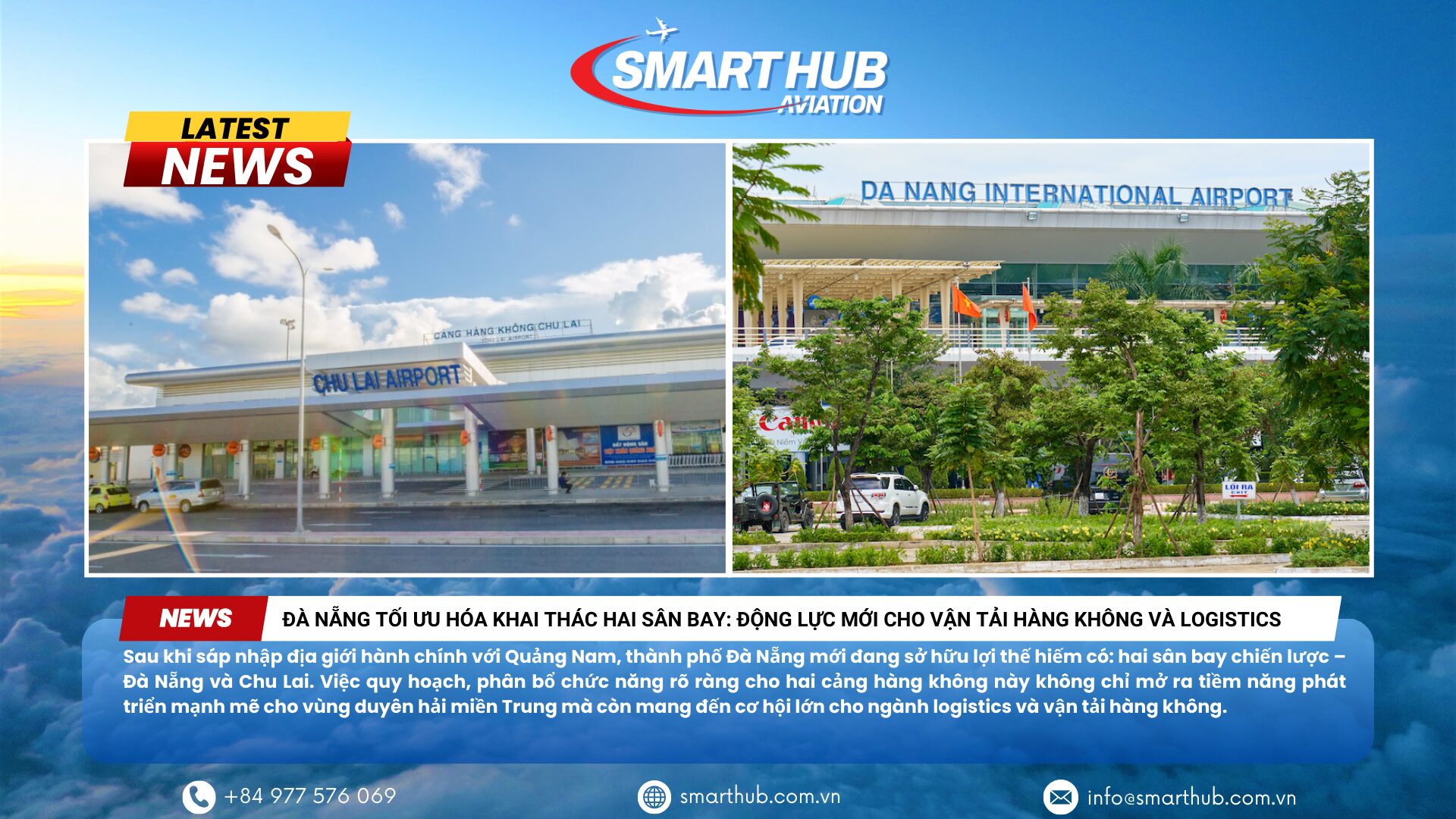
Development Potential from Two Strategic Aviation Hubs
Da Nang International Airport is currently the third largest airport in Vietnam, handling nearly 13.5 million passengers in 2024. Under the master plan for 2030, its capacity is expected to increase to 25 million passengers and 100,000 tons of cargo annually. Looking ahead to 2050, these figures could reach 30 million passengers and 300,000 tons of cargo per year.
Meanwhile, Chu Lai Airport — spanning over 2,097 hectares — is being developed into an international cargo transshipment hub and a major aircraft maintenance center. For the 2021–2030 phase, Chu Lai aims to reach 10 million passengers and 50,000 tons of cargo annually, with a long-term vision to handle 30 million passengers and 3 million tons of cargo per year by 2050 — the highest projected capacity among all Vietnamese airports.
This demonstrates that, beyond serving as a key gateway for tourism and international travel in Da Nang, Chu Lai Airport is designated to take on a critical role as the regional air logistics hub, supporting international transshipment and specialized cargo transport.
>>>> FOR YOU: Packaging Goods in Air Freight: Complying with IATA Standards to Optimize the Entire Journey
Early Planning Adjustment and Synchronization Needed

Clearly defining the roles of Da Nang and Chu Lai airports is key to optimizing resources and unlocking the full potential of both aviation hubs.
With Da Nang now overseeing two major airports, it is imperative that local authorities and central agencies establish distinct roles and functions for each airport to avoid overlap and resource inefficiency.
According to the Airports Corporation of Vietnam (ACV), plans are underway to expand Terminal 1 and upgrade the international Terminal 2 at Da Nang Airport. Additionally, ACV has expressed readiness to fund the hiring of international consultants to develop a comprehensive and modern master plan for both airports.
The city is also pushing forward infrastructure connectivity, including expanding expressways and investing in urban railways, to shorten travel time between the two airports. Prior to the administrative merger, Da Nang had already set up a task force to study a metro line connecting to Quang Nam. Following the merger, this line is now considered internal transportation — providing significant advantages in terms of planning and management.
Vision: Smart Aviation – Green Aviation

The global aviation industry’s shared objective is to adopt sustainable aviation fuel.
In the context of digital and sustainable economic development, the Ministry of Construction has recommended that the newly merged Da Nang integrate elements of “green aviation” and “smart aviation” into its master planning. This means aligning with international environmental standards, embracing digital transformation in operations, and developing airports with integrated logistics, renewable energy use, and data-driven optimization.
With the strategic advantage of Chu Lai Airport — offering vast space unencumbered by urban development — the establishment of a high-tech air logistics zone, international distribution center, and cargo transit hub is entirely feasible. This would serve as a critical component of the global supply chain, especially as Central Vietnam increasingly attracts foreign direct investment (FDI).
>>>> YOU MAY ALSO BE INTERESTED IN: The Technological Revolution is Reshaping the Air Cargo Industry
Opportunities for Air Logistics and Service Enterprises

Boeing 777F and Airbus A330F – Specialized Air Cargo Solutions to Propel Central Vietnam’s Logistics Hub.
Clearly defining Da Nang’s role as a hub for tourism and premium commerce, and Chu Lai’s as a center for cargo transport and international transshipment, will lay the foundation for sustainable regional development.
Notably, if plans to invest in dedicated air freighter fleets such as the Boeing 777F and Airbus A330F are implemented alongside the development of supporting infrastructure—warehouses, aprons, and cargo sorting centers—Central Vietnam could emerge as a competitive air logistics hub, rivaling major centers like Ho Chi Minh City or Hanoi.
Moreover, businesses across the supply chain—from freight forwarding, warehousing, customs clearance to logistics services—can seize this opportunity to invest or expand operations tailored to the growing demands of air cargo.
Smart Hub Aviation – Strategic Partner in Central Vietnam’s Air Logistics Chain
As a provider of comprehensive air freight solutions, Smart Hub Aviation (SHA) is ready to accompany businesses through the next stage of development for the Da Nang – Chu Lai airport cluster.
With deep expertise in air routes and Central Vietnam’s logistics ecosystem, SHA offers:
- Tailored freight transport strategies for each cargo type and route
- Consolidation, deconsolidation, and flexible on-airport warehousing solutions
- Customs declaration and export–import documentation support, ensuring correct port codes and timelines
- Specialized services for hazardous goods, perishables, and sensitive cargo
- Nationwide and international logistics network integration to optimize delivery time and cost
>>>> READ MORE: Comprehensive Air Freight Solutions from Smart Hub Aviation
Contact Us:
- Hotline: +84 977 576 069
- Email: info@smarthub.com.vn
- Fanpage: Smart Hub Aviation
Share the posts
.svg)
.svg)
.svg)
 Copied
 Blog Related

E-commerce Cargo – Fast & Efficient E-commerce Shipping Solution

Vietnam Air Cargo Transport: Breakthrough in the First 9 Months of 2025 – A Golden Opportunity for Import–Export Businesses

Van Don International Airport – The Golden Gateway for Air Cargo Transport

China Opens 152 New Air Cargo Routes – A Golden Opportunity to Strengthen Vietnam’s Supply Chain Connectivity

Air Cargo During the Vietnam National Day: Strong Growth in Cargo Volume Creates Opportunities for Vietnam’s Logistics Industry


